
Prefer watching? The video is in Indonesian with English subtitles: Watch "Gue Ganti Kursi Gaming Jadi Kursi Kantor IKEA SMÖRKULL" on YouTube.
My gaming chair had reached the point where the seat no longer had a seat. The foam had compressed into something closer to cardboard, and sitting in it for a working day had turned into a slow negotiation with my own spine. The frame was still perfectly solid, which was the part that bothered me the most.
So before I bought anything, I asked a much less obvious question: if the foam is the thing that wears out, why does the entire chair have to be thrown away with it?
The problem was never the frame
Every chair I've owned died the same way. Not from a snapped base, not from a broken gas lift, not from a cracked armrest. From the foam.
And each time, there was exactly one fix available: buy the whole chair again. No part to order, no cushion to replace. The foam was the failure point and it was the one thing I couldn't buy separately.
So I wasn't looking for the best-looking chair, or the one with the most adjustments. I was looking for a chair where the foam was (a) genuinely firm, and (b) theoretically replaceable later without trashing the rest of it.
That second criterion is the whole reason I ended up at IKEA.
The spec that made me drive across town
Searching online, the IKEA SMÖRKULL turned up for a specific reason: IKEA states that the seat and backrest covers can be taken off and machine-washed.
That is a small line in a product description, but it's a bigger deal than it sounds. If the cover comes off, then in principle someone who works with upholstery can get at the foam underneath — so in three or four years, if the seat flattens again, I might be able to have the cushion rebuilt instead of buying another chair.
IKEA Indonesia lists the seat foam as high-resilience polyurethane cold foam at 65 kg/m³ — the same class of foam used in their more expensive office chairs — with the chair tested for 110 kg, a 10-year guarantee, and a price of Rp2,499,000.
But I'd spent enough time reading about foam to know that one number doesn't buy you certainty.
Density is not firmness, and it's not a promise
This is the part of my research that changed how I read spec sheets.
Foam density and foam firmness are two different properties. A high-density foam can still feel soft, and a low-density foam can feel firm on day one. Density mostly tells you how much material is in there, which is a decent durability signal — but it isn't a statement that the foam will still be supportive after a year of eight-hour days at my body weight.
I also hit a reminder that spec sheets are written by humans. Two IKEA product pages listing the same seat-frame component described the foam differently — one noted the cold foam and its density, the other said only "polyurethane foam". Probably a documentation lag rather than a different foam, but it taught me to check the spec on the page for the exact article number I'm buying, not on a page I found through search.
So the specs got the chair onto my shortlist. They didn't get it into my car.
Specs don't sit, so I went and sat in it
The showroom visit was the actual decision. My eyes had already browsed online, but my back and butt hadn't, and they're the ones who have to live with it.
What I did at the showroom was deliberately unglamorous: sit down, lean back, shift around, sit for longer than a polite amount of time. I wasn't checking whether it looked right — I was checking whether the foam pushed back. Against the other chairs I tried that afternoon, its seat was among the firmest, and the shape wasn't trying to be a racing seat.
One number I'd flag for anyone doing the same thing: the seat depth is 49 cm, and it isn't adjustable. A deeper seat isn't automatically better — if the front edge presses into the back of your knees when you sit all the way back, you'll spend the whole day sliding forward. Sit in it for a good twenty minutes, not twenty seconds, and check there's a couple of fingers of room behind your knee before you commit.
Buying the box and building the chair
In the warehouse, the chair is just a box, and it is a heavy one — around 17.5 kg of parts. I pushed it to the car, drove home, and opened it in the yard.
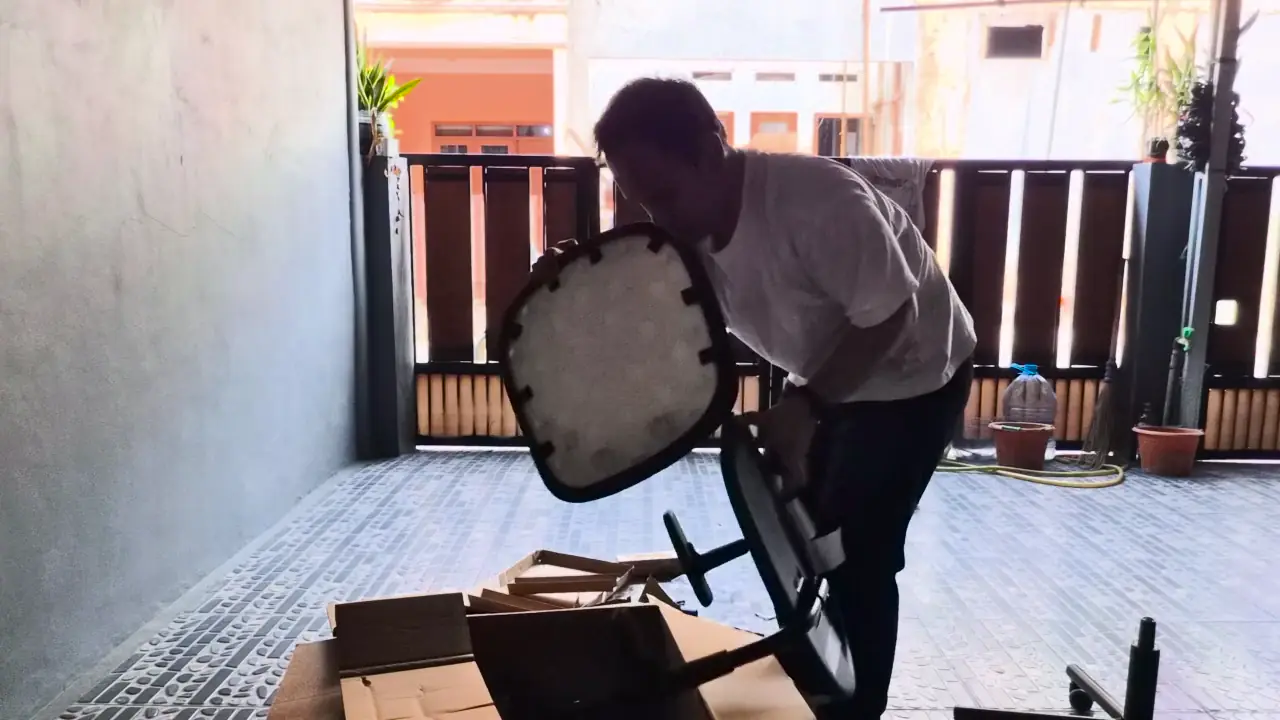
Unboxed, it's a set of loose pieces: legs, seat, backrest, and hardware. The showroom version is already assembled and looks effortless, so it's easy to assume you know the build. You don't. I read the manual first, and if you build one, do the same — watching a finished chair and assembling one from a box are different skills.
The moment that mattered to me, though, was mid-build, when the seat and the backrest were sitting apart on the floor.
The upholsterer plan — and the honest caveat
That's the payoff of the removable covers: with the seat and backrest separated, access isn't the problem.
But I want to be precise about how far that reasoning actually goes, because it's easy to oversell it. The covers coming off does not mean the foam comes out. I have not had this chair serviced, and I have not confirmed with anyone that the foam can be lifted out without destroying adhesives or the internal structure. It's a plausible plan, not a proven one — it needs an upholsterer to look at the real thing.
If it does come to that, the brief would be specific: high-resilience foam around 60–65 kg/m³ rather than cheap seat foam, keep the original thickness and contour so the ergonomics don't change, and reuse the original cover if it's still in good shape.
And there's an order of operations here that matters more than the plan itself. The chair carries a 10-year guarantee, so if the foam genuinely collapses, the first move is IKEA, not the upholstery shop — ask whether it's covered, and ask whether having a third party redo the seat affects the rest of that guarantee. Modification is exactly the kind of thing warranties are written to exclude. If warranty says no, then it's an upholsterer. Not before.
What this post is not
This is not a review, and I want to be clear about that rather than let the enthusiasm carry it.
I assembled this chair recently and have used it for a short time. Comfortable in the first week is a very low bar, and it proves nothing about month eight. The whole reason I bought it was long-term durability, and the honest answer to "does the foam hold up?" is that I don't know yet and can't know yet.
What I can say is that the decision process was different from every chair I've bought before. In the past I picked a chair, used it, and then found out that the one component I'd eventually throw the chair away over was the one nobody would repair. This time I started from that component and worked backwards.
If there's a 12-month follow-up to write, it'll be about whether that reasoning survived contact with daily use.
So, genuinely curious: if your chair's foam gives out while the frame is still fine, do you find someone to rebuild the cushion, or do you just buy a new chair?
(Watch the full trip: I swapped my gaming chair for an IKEA SMÖRKULL)