This article is the written companion to my video breakdown on YouTube. You can watch the full video walkthrough here:
Watch on YouTube: Medallion Architecture Explained
In almost every data platform I've worked on, the incoming data from application databases, APIs, event streams, and spreadsheets is messy. You run into duplicate events, inconsistent timestamp formats, missing fields, and corrupted payloads.
When I talk to junior engineers or stakeholders, the central question is always: how do you turn this unpredictable raw stream into trustworthy metrics that drive business decisions without building fragile, monolithic pipelines?
My go-to design pattern for solving this is the Medallion Architecture.
What is the Medallion Architecture?
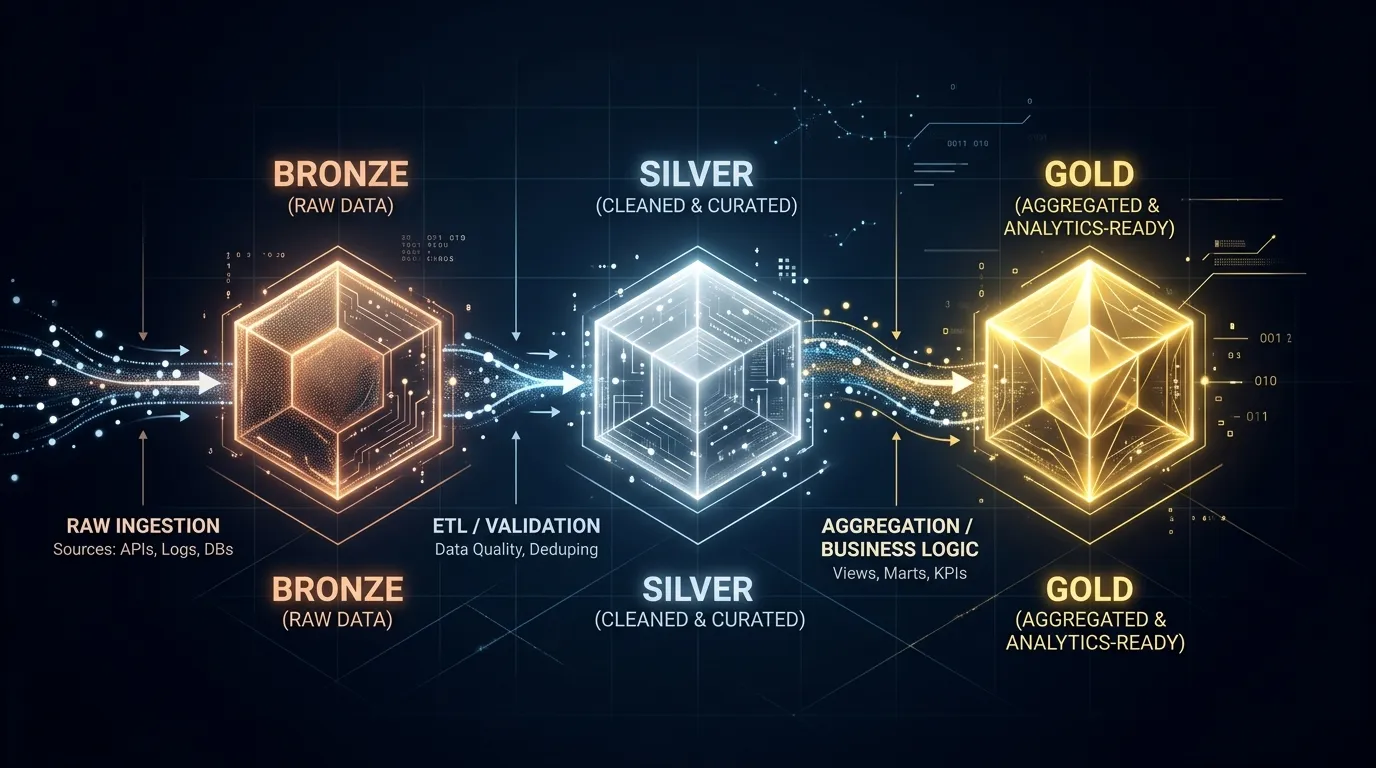
The Medallion Architecture is a data design pattern that logically organizes data into layers based on its quality and structure.
The three most common layers are:
- Bronze Layer, for raw data.
- Silver Layer, for cleaned and standardized data.
- Gold Layer, for business-ready data.
The core idea is simple. Instead of cramming all ingestion, cleaning, joining, and aggregation processes into one massive, complex pipeline, the data is processed in stages.
As data moves from Bronze to Gold, its quality, structure, and trustworthiness increase.
graph LR
  Raw[Raw Data] -->|Ingestion| Bronze[(Bronze Layer)]
  Bronze -->|Cleaning & Validation| Silver[(Silver Layer)]
  Silver -->|Business Logic & Aggregation| Gold[(Gold Layer)]
  Gold --> BI[Dashboards & Reports]
The Bronze Layer: The Historical Landing Zone
Let's start with the Bronze Layer.
Bronze stores data as close to its original state as possible. For instance, if an application sends an event in JSON format, it is typically saved exactly as-is in the Bronze layer.
If there are duplicate records, null values, or inconsistent date formats, they still enter Bronze untouched.
This might sound strange. Why intentionally save bad data?
Because the primary function of the Bronze layer is not to provide ready-to-use data for analysis. Its main purpose is to serve as a historical landing zone and the ultimate source of truth for all data that ever entered the system.
Bronze is incredibly useful for auditing, troubleshooting, replaying data, and rebuilding pipelines.
For example, if a business rule changes in the future, the data team can simply rebuild the Silver and Gold layers using the historical data safely stored in Bronze—without needing to re-extract everything from the source application.
Typically, the Bronze layer also adds essential technical metadata, such as ingestion timestamps, source system identifiers, file names, partition dates, or batch IDs. However, heavy business transformations should be strictly avoided here.
To use a simple analogy: Bronze is like the receiving dock at a warehouse. Every package that arrives is recorded first, exactly as it is, before it is opened or processed.
The Silver Layer: The Trusted Data Foundation
After Bronze, we move into the Silver Layer.
This is where the raw data is cleaned and standardized. Common processes in the Silver layer include deduplication, data type validation, timestamp standardization, null handling, and filtering out corrupted records.
This is also where data from multiple sources begins to be integrated. For example, customer data from a CRM might be joined with transaction data from a payment system.
In the Bronze layer, the data structure usually mimics the source system. But in the Silver layer, data is shaped into reusable business entities—such as customer, product, order, account, or transaction.
The key word here is reusable.
Silver tables should not be built just to serve one specific dashboard. Instead, Silver must be a trusted data foundation utilized by multiple teams across various use cases.
For instance, a single transaction table in the Silver layer can be used by the finance, risk, product, and marketing teams. Each team might build their own distinct Gold tables on top of it, but their trusted data source remains the exact same Silver table.
If Bronze is the receiving dock, Silver is the processing room. The boxes are opened, checked, cleaned, labeled, and organized so everyone understands exactly what's inside.
The Gold Layer: Ready for Business
Finally, we have the Gold Layer.
Gold contains data that is specifically modeled for business consumption. This includes metrics like daily revenue, monthly active users, average order value, customer lifetime value, fraud indicators, or executive KPIs.
Data in the Gold layer has typically undergone heavy aggregation, dimensional modeling, or specific business calculations. It is highly optimized for dashboards, reporting, machine learning features, or data applications.
For example, while the Silver layer might have a transaction table containing millions of clean records, the Gold layer will transform that data into a summary table showing daily revenue grouped by product, region, and payment method.
Because data quality issues have already been handled in Silver, Gold can focus purely on business logic and query performance. Definitions like "active customer", "successful transaction", or "net revenue" are implemented in this layer.
In our analogy, Gold is the storefront window. All the raw materials have been processed, and the final products are perfectly arranged and ready for the end user.
Why Not Just Use One Pipeline?
You might be asking: Why not just clean the raw data, join it, and build the dashboard all within a single pipeline?
Technically, you can.
But as the pipeline grows, it becomes increasingly difficult to test, debug, and maintain. By separating the data into logical layers, each layer has clear and distinct responsibilities:
- Bronze preserves the raw historical data.
- Silver produces clean, standardized, and reusable data.
- Gold delivers specific business value and metrics.
If a KPI definition changes, you usually only need to rebuild the Gold layer. If the cleaning logic changes, you can rebuild Silver and Gold entirely from Bronze—all without re-extracting data from the source systems.
This layering makes your pipelines more traceable, maintainable, reusable, and much easier to recover when something goes wrong.
A Practical Example and Recap
Let's look at a practical example of an online store:
- Bronze receives the raw order event directly from the application.
- Silver handles deduplication, validates the pricing, standardizes the timestamps, and outputs a single, trusted order record.
- Gold takes those trusted records and calculates the daily revenue, average order value, and top-performing products.
The shortest possible recap:
Bronze is raw.
Silver is trusted.
Gold is useful.
The Medallion Architecture isn't a magic solution for every data problem. However, this pattern provides a clear, scalable structure for transforming messy data into highly reliable business information.
And that is the core concept of the Medallion Architecture.
(Watch the full video explanation on YouTube)